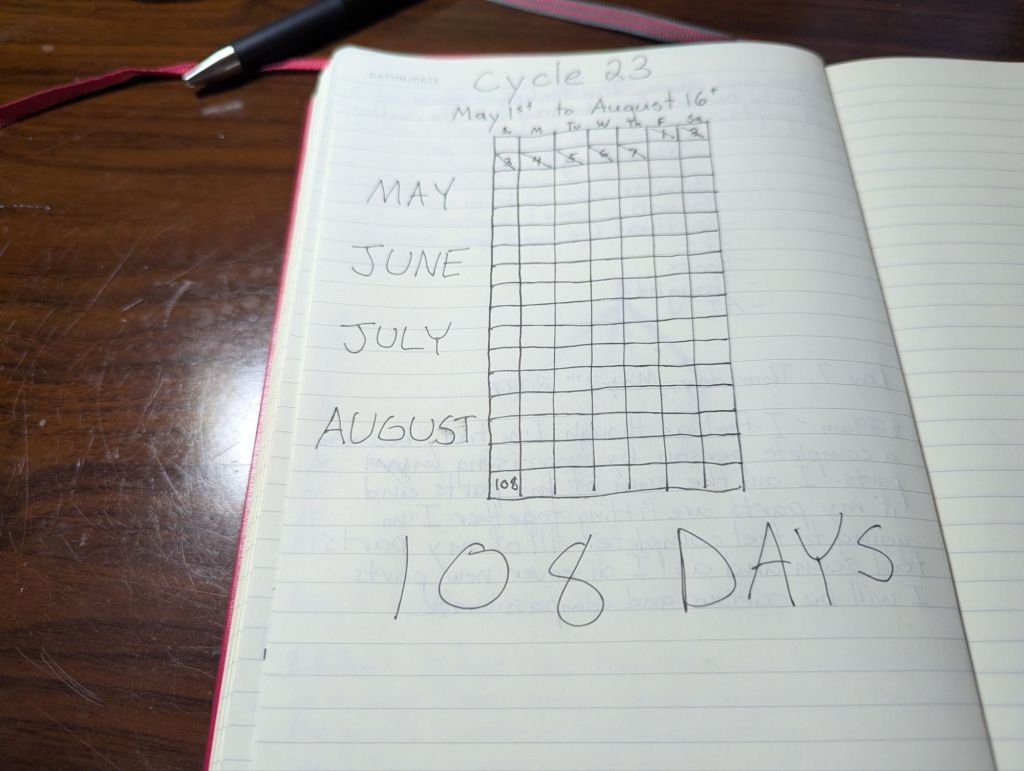
Are you serious about personal development? Consider living your life 108 days at a time, starting on Jan 1, May 1, and Sep 1.
Living this way gives you three focused periods each year, letting you achieve more growth, change, and opportunity than a single long stretch. If I had to condense the benefits into a single word, it would be more. Let’s explore why this matters:
Here are eight reasons why you should adopt the 108-day cycle.
1. More Experimentation
If you only rely on New Year’s Resolutions, you only get one shot at a major life pivot every 365 days. In contrast, the 108-day cycle gives you three distinct windows to try new things. More experimentation means…
2. More Failing
Failure is a vital part of learning. In a 108-day cycle, failures have lower stakes because a reset is near. You can afford mistakes, knowing a new cycle is coming soon, which enables more growth. More failing is…
3. More Data
Data is what you need to solve the problems life throws at you. By trying new things and failing fast, you harvest data from experience to close the loop. There are endless books, podcasts, and “life hacks” out there, but the only way to find what works for your biology, environment, and schedule is through this loop. As you collect more data, the winning experiments eventually become…
4. More New Habits and Routines
You are the sum of your habits and routines. This is where real self-improvement happens. You experiment until you find a rhythm that works, and then you hard-code it into your daily life. Consistency becomes possible because of…
5. More Ritual Resets
New Year’s Resolutions are powerful because they leverage “social proof” and “fresh-start” energy. But the problem is a lack of planning; when people fail in February, they usually wait ten months to try again. They lose the lesson because they lose the momentum. Instead, what you actually need is…
6. More Time to Reflect and Plan
The 108-day cycle’s greatest advantage is the built-in pause: after each 108-day stretch, you get about two weeks to step back, analyze what worked, and intentionally plan your next actions. This clarity makes progress easier than ever.
Consider the example of a smoker trying to quit for New Year’s. If they fail after two months, they might wait another ten months before trying again—by which point they’ve forgotten exactly why they lapsed. If you are living 108 days at a time and fail at the two-month mark, you’ll be in a reflection and planning phase in less than eight weeks. You can analyze the failure, adjust the plan, and try a new approach immediately. By the third cycle of the year, you may have already mastered it. This efficiency leads to…
7. More Done in Less Time
Every goal you have—writing a book, upskilling for a better job, or starting a side hustle—is directly tied to a routine. When you master the art of building these routines through 108-day sprints, you naturally get more done in less time. Rather than drifting, you start executing—leading directly to…
8. More Agency
Not everyone wants more agency, but if you’re reading this, you probably do. The speed with which you can move through these cycles of reflection, planning, and acting increases your ownership of your life.
This isn’t just about productivity or money; it’s about gaining mastery over the forces—both internal and external—that pull you in directions you don’t want to go. 108 days is the “Goldilocks Zone”: long enough to refine complex habits, but short enough to maintain urgency.
As James Clear, author of Atomic Habits, points out:
“On average, it takes more than 2 months before a new behavior becomes automatic — 66 days to be exact. And how long it takes a new habit to form can vary widely depending on the behavior, the person, and the circumstances. In Lally’s study, it took anywhere from 18 days to 254 days for people to form a new habit. In other words, if you want to set your expectations appropriately, the truth is that it will probably take you anywhere from two months to eight months to build a new behavior into your life — not 21 days.”
By living 108 days at a time, you create a focused period to make habits automatic, evaluate their impact, and define the next steps—ensuring that change is both consistent and intentional.

